





BSRIA Water Treatment for Closed Heating and Cooling Systems BG 50/2021
|
Contents |
[edit] Introduction
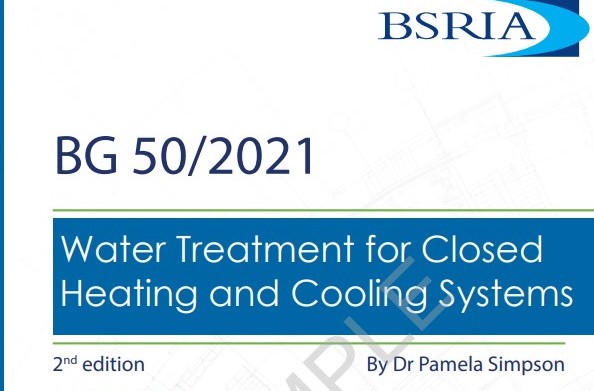
In November 2021, BSRIA published the second edition of its Water Treatment for Closed Heating and Cooling Systems (BG 50/2021). This updated version supersedes BG 50/2013 and is available to purchase from the BSRIA Bookshop. It is also being offered to BSRIA members as a free download.
[edit] Background
Water treatment is essential in closed heating and cooling systems. Without it, there is far greater risk of biological fouling (also known as biofouling), corrosion and scale. These problems can lead to poor performance, system failures and costly remedial works.
BSRIA first published guidance on water treatment in 1993. A major overhaul of this older guide, including a change of scope, occurred in 2013, at which point it was renumbered and renamed: BG 50/2013 Water Treatment for Closed Heating and Cooling Systems.
This guide became widely used in the industry; however, it became clear that it needed an update to bring it in line with current technology and practices and updated standards and guidance. In particular, this revised edition is consistent with Pre-Commission Cleaning of Pipework Systems (BG 29/2021), which was published in February 2021.
The technical content of the publication was written by Dr Pamela Simpson with the help of a steering group, including representatives from the British Chemicals Association (BCA), the Closed Systems Control Association (CSCA), the Industrial and Commercial Heating Equipment Association (ICOM), the Institute of Corrosion (ICorr), the Institute of Workplace and Facilities Management (IWFM) and the Water Management Society (WMSoc).
[edit] What does BG 50/2021 cover?
At present, chemical water treatment is the dominant water treatment technique for closed heating and cooling systems in the UK. Therefore, this technique is covered in depth in the guide. Other techniques are also available, and a number of these are covered in the guide, including:
- Pre-treatment of fill water.
- Removal of dissolved gases.
- pH management.
- Solids removal and filtration.
- Galvanic anode cathodic protection/electrochemistry.
- Bacteria and biofouling inhibition by biocides.
Expanded guidance has been provided on the roles and responsibilities of those typically involved with water treatment in closed systems: planners of water treatment programmes, maintenance water treatment specialists, day-to-day system operators, building owner/operators and remedial cleaning specialists.
The suggested water quality analyses and guidelines have been updated, including the addition of corrosion rates. Additional guidance has been provided on corrosion monitoring and on-site testing, including the use of test kits.
This article originally appeared on the BSRIA website under the headline, 'BSRIA launches update to Water Treatment for Closed Heating and Cooling Systems'. It was published in November 2021.
--BSRIA
[edit] Related articles on Designing Buildings
- Biological fouling.
- BSRIA articles on Designing Buildings Wiki.
- Chilled water.
- Closed system water treatment: BG 50 & VDI 2035.
- Commissioning building systems.
- Heating ventilation and air conditioning.
- Pipework.
- Training for pre-commissioning cleaning of pipework systems.
- Water treatment.
[edit] External resources
Featured articles
Check out some of the best features and news from Designing Buildings as well as key stories from around the web.
World's first mass timber data centre.

The overlooked environmental aspect of data centre development.
Introduction to radon awareness

New technical information sheet published by CIOB.

Updated supplier guide can help electrical contractors engage with NHP.

CIAT confirm the winners of the 2026 architectural technology awards.

Government launches a one stop shop for flood preparedness.

Sir Edwin Lutyens: Britain's greatest architect? Book review.

CIOB publishes free template to help assess and manage risks.
ECA's reflections on Party Conference season

Burnham wants to be confident of winning before asking for a fresh mandate.
New Chief Construction and Scientific Adviser

Sergio Cavalaro, Professor of Infrastructure Systems at Loughborough University.
Building safety levy for England

CIAT publish estimator tool for members.

Water sector faces a growing crisis that could slow the delivery of vital infrastructure.
Undervaluing our industrial past

Heritage value changes as taste for building styles changes.